
Keyword Research: How to do it
Keyword research is a phrase you’ll hear about a lot in SEO. It’s essentially finding the phrases that people type into search engines to find the information they’re looking for.
Simple, right? The trick is to find the right keywords. They need to be relevant to your business so you can increase your visibility and get more people coming to your website that actually want to buy from you.
It’s a fairly straightforward process, and we’ll walk you through where to start and how to do your own keyword research – you’ll be a pro in no time!
Let’s start with the basics on what exactly keywords are and why you need them for your website to succeed.
What do we mean by keywords in SEO?
Keywords are the exact words and phrases that people type into search engines to find information or products. For example, say you’ve just arrived in Kirkwall for the day and you want to find a good cup of coffee. You might type “coffee shops near me” to find a place you like the sound of.
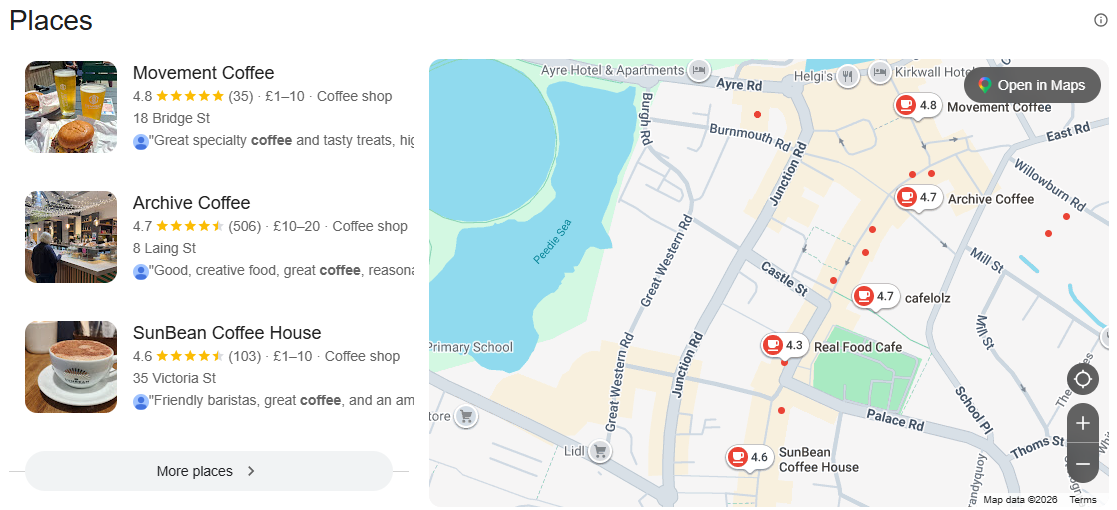
Example results of “coffee shop near me”
Or, maybe you’re shopping for a new pair of shoes. You’re unlikely to just type ‘shoes’ because that would bring up nearly everything relating to footwear. Instead, you might type ‘size 6 womens trainers’ to find something specific, or if you’re looking for guidance on what to buy you might search for ‘most comfortable womens trainers 2026’.
Why are keywords important for you?
Think of Google like a directory. You want your website to be listed on it for as many pages as possible; keywords are the ‘code’ that search engines use to find and understand what each individual webpage is about and what users will find on it. Google matches the most relevant content with each keyword to show users what they’re looking for.
It means that for each page you have on your website, you have an opportunity to target a specific keyword so that you’re maximising the chance to be found in a variety of different searches.
You can also use keyword research to find topic ideas for you to write about that will be relevant for your brand so that you’re creating content that matches the needs of your target audience.
How to do keyword research
1 - Find a keyword research tool
There are lots of tools available online for conducting keyword research. Many of them require you to pay, but lots of them have free versions that you can use for a limited number of searches. Moz and Ahrefs are good examples.
Keyword Tool and Google Keyword Planner are both free to use. These tools take information from Google to give you keyword ideas, and data on how popular particular keywords are. All you need to do is navigate to the ‘keyword research’ section, type in the topic, and hit search.
2 - Start with a ‘seed’ keyword
A ‘seed’ keyword would be a broad term that matches what your brand or product is all about. For example, ‘local coffee beans’ or ‘Orkney jewellery.’
Let’s use ‘Orkney Jewellery’ and see what information we can get (we use SE Ranking as our keyword tool):
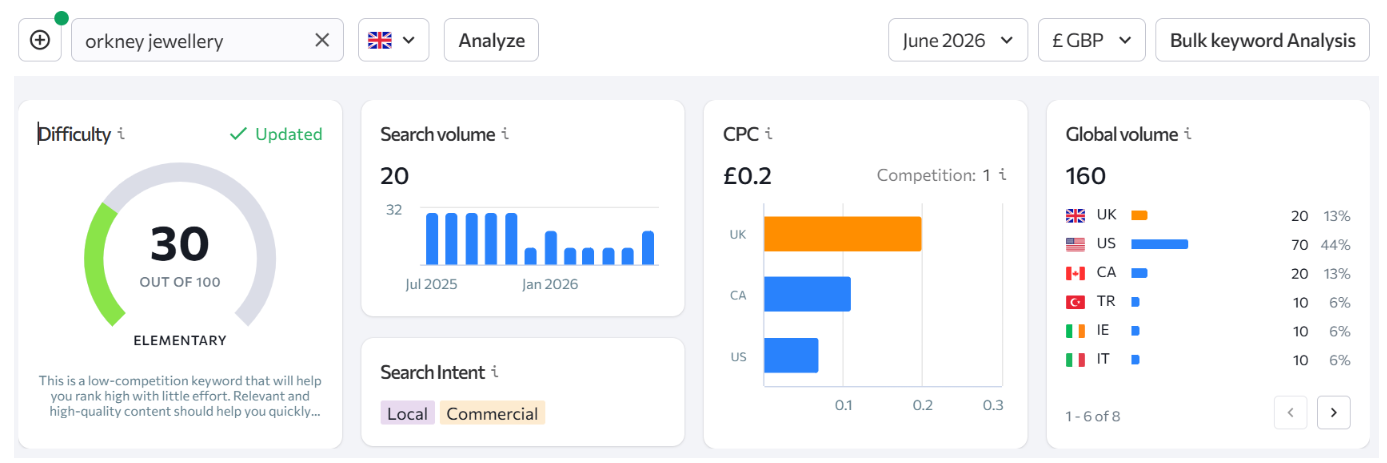
Example dashboard from SE Ranking
This gives us information on how difficult this keyword might be to rank for, how many searches it gets per month (on average), what the search intent is and where these searches come from.
Pro tip: jot down a couple of different ideas for seed keywords and try out each one to see what you can find.
3 - Look at similar and related keywords
Scrolling further down the page, we can also see a list of similar and related keywords which show what other phrases people search for.
This is a great way to find useful keywords to optimise your key pages and to find new angles or areas to cover on your site.
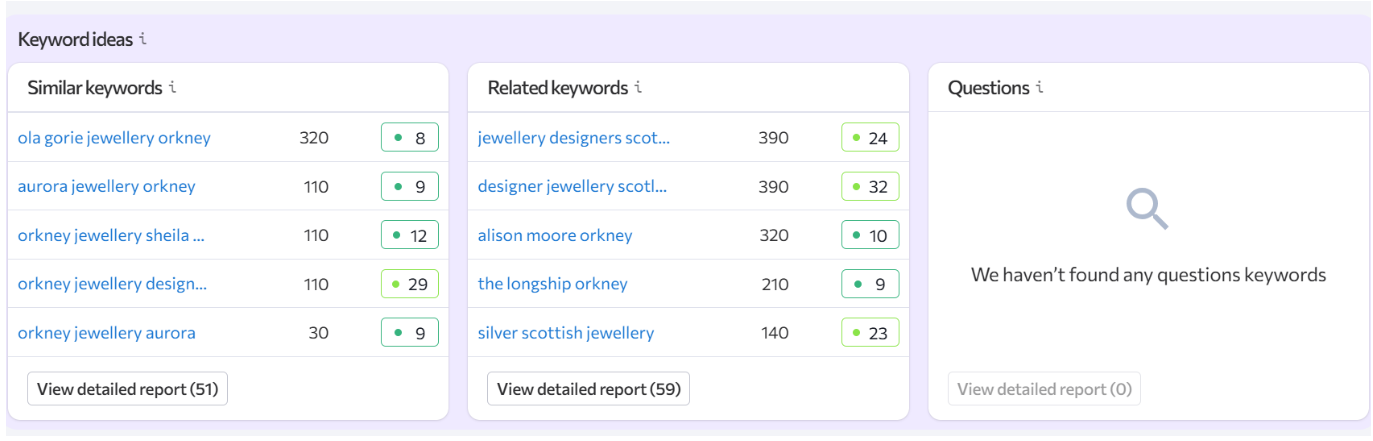
Examples of Similar Keywords from SE Ranking
Keep a note of all the keywords you want to use and you can gradually start to incorporate them into your website content. Most SEO tools have an option to download your keywords as a CSV file.
4 - Look at keyword difficulty and search volume
Each keyword will give a rating from 0-100 based on how difficult it is to rank for that keyword. The lower the rating, the higher the chance of being able to rank for it (by ranking we mean showing on the first page of Google).
Keywords with a high difficulty rating mean that there’s more competition, and likely from big, established websites that would be hard to compete with.
The other thing to look at is the search volume for your keywords. This is the average number of searches they get per month.
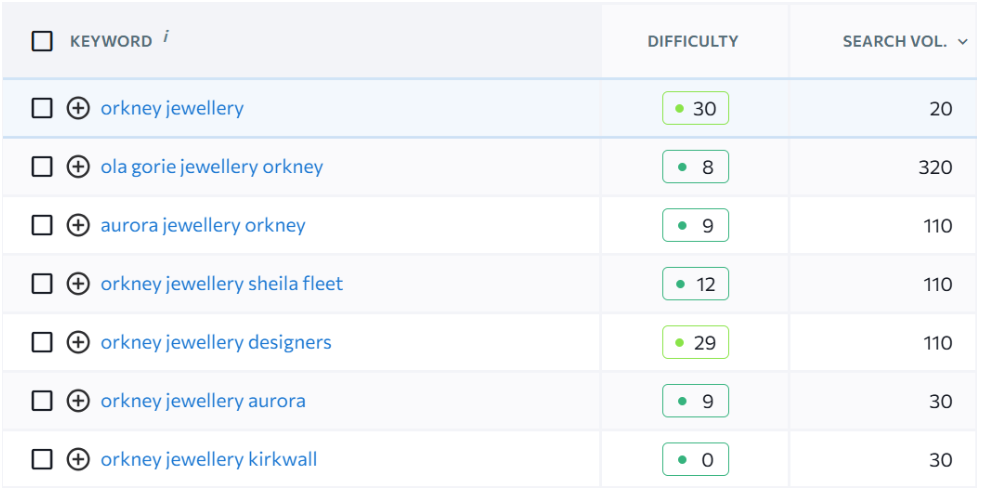
Examples of keywords and their difficulty rating
As you can see here, ‘Orkney jewellery’ has a difficulty rating of 30 and gets an average of 20 searches a month. In comparison, ‘Orkney jewellery Kirkwall’ is much easier to rank for, and has a higher number of monthly searches, so you might decide to target that keyword instead.
There’s a bit of analysis to do on your part as you can see, but the best way to do it is just to play around and have a practice. The main thing to prioritise is choosing keywords that are relevant to your business and your content.
5 - Choose the right search intent
Another term you’ll see in your keyword research tool is ‘search intent’. This is the category or type of page a user is expecting to find when they search for that keyword. There are four main types of search intent:
Informational: users want to learn about a topic or answer a question
Commercial: people are researching products before deciding what to buy
Transactional: these users are ready to make a purchase
Navigational: users who are searching for a specific page
This is important because it tells you which keywords are suitable for different types of content. For example, informational keywords might work best as blog content or FAQs, and commercial or transactional keywords are ideal for your product pages.
Using your keywords
Now that you’ve got some keywords you’re happy with, the next step is to incorporate them into your website content.
The key places to focus on are:
Your H1 headings
The page title (also known as the meta title)
The meta description
Within the page text (ideally within the first paragraph)
Our blog The Fundamentals of Good On-Page SEO goes into this in more detail, so check it out once you’ve done your keyword research and you want to know what to do next.
