
AI Search Strategy: How to Show Up in AI Search
Primary keyword: AI search strategy
Secondary keyword: AI search
AI search is changing the way people search for and access information, so it’s important to be aware of how it works.
When you search for information on Google, you’ll no doubt see the AI overview which often appears at the top of the search results.
This is one example of AI search, but there are other platforms people might use to search for information, like Chat GPT.
We’ll cover what AI search is, how it’s different from SEO and four simple tips you can apply to your own AI search strategy.
What is AI Search?
AI search is just a different way of searching for information online and being presented with the desired answers. The simplest form of it is the AI overview on Google search: you google something as usual, and it gives you an AI generated summary at the top. Or, you can click on ‘AI mode’ and you’ll see what’s essentially a larger version of that.
Here’s an example of the AI overview for the query ‘AI search statistics 2026’:
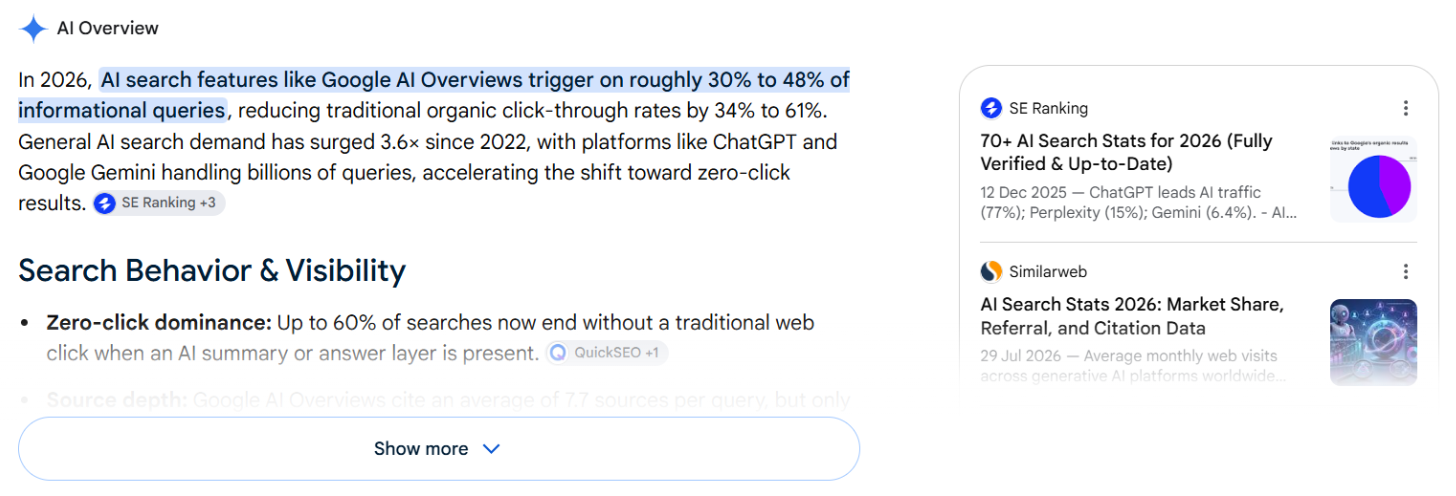
AI overview for “AI search statistics 2026”
AI search is also done through AI platforms like Chat GPT, Perplexity and Gemini which are known as Large Language Models (LLMs). Users will ask a question, and it will give them an answer without the need to visit websites to find the information they want. They also turn the experience into more of a conversation.
How is AI Search Different From SEO?
You might see acronyms like GEO or AEO being thrown around to describe AI search, but essentially, it’s still SEO – it’s just another layer to how people search.
The key difference is in the way that users interact with AI and how they consume content. Let’s say I’m using Chat GPT to find information. I can type out a longer, more specific question such as ‘help me find a cute sundress that’s butter yellow with flowers on it, that isn’t too short and doesn’t have thin shoulder straps in a size 10’.
It involves more conversation, and it gives back a detailed response which you can reply to and narrow down your search further.
For website owners, the difference is that users might not be visiting your website to find out about your brand – instead they’re being told about it by AI.
An AI answer regurgitates content it finds online and rewords it based on the model’s understanding of the topic and what it can find online. Content and websites which are prominent in Google search are still the most likely sources it will pull from, so it’s important to focus on the basic principles of SEO first so that your brand can be as visible as possible.
AI Search Optimisation Tips
AI Search can feel a bit overwhelming to begin with, but you don’t need to make big changes or invest in expensive tools to get your brand to show up. There are a few simple principles you can apply to improve the visibility of your brand and make it more likely that AI will mention you in related searches.
Use AI search to research your brand
The best place to start is to spend a little time analysing what AI search results are currently like for your niche or topic areas. Open up your AI tool of choice and type in questions that are relevant to your business – think about what your target audience might be looking for – and see what comes up!
If you’re already mentioned, that’s great! But if not, this is a good opportunity to see how your competitors are being talked about, and whether there are gaps in your content you can address.
Another way you can do this is to use AI search or SEO tools to monitor your brand visibility. Some of them will give you a snapshot of the answers each AI tool is giving people, but it’s important to keep in mind that the exact answers are likely to vary from user to user. Your overall visibility is the most useful thing to focus on.
Directly answer questions in your content
While you can’t control what AI will say about you, you can structure your own content in a way that makes it easier for LLMs to scan and understand. This improves the chances of them citing your content in AI answers.
The simplest way to do this is to structure your content in a question/answer format and give a clear, direct answer right away.
For example, say you have a business selling handmade arts and crafts. You could answer questions that your customers are likely to ask, like:
How long does delivery take? (this would be your heading)
Delivery takes 7-14 days after placing your order. Each item is carefully handmade to order, and you’ll get a confirmation email to tell you when it’s in the post. (Answering the question first, then adding context second).
You can find ideas for relevant questions by looking at the ‘people also ask’ section in Google for your topic, which can be useful for finding gaps in your current content, or by using keyword research tools to see what people are searching for.
Use statistics and original research
AI tools are more likely to reference content which contains specific facts and statistics, rather than vague or general statements.
For example, if I wanted to make this article more AI search friendly, I might say something like: While AI search is important, a recent study by Brightedge found that 68% of online search activities start on search engines.
You can also showcase your own data and expertise, to show that you’re a credible source of information.
The more authoritative your content is, the more likely it is to be cited in AI search.
Using your own original content gives you the best chance to stand out, because you’re offering something different and giving your own take on a topic.
Keep your content fresh and up to date
Maintaining your content to keep it relevant and accurate is another simple, but effective way to improve your overall visibility.
Both search engines and AI bots like fresh content. If a page shows it hasn’t been updated since 2022, it might signal that it’s outdated, making them more likely to cite content which has been refreshed earlier this year.
You don’t need to make big changes to keep your content fresh.
It could be as simple as rewording a paragraph that’s no longer relevant, adding new imagery or rewriting the introduction of a blog post to add a new perspective.
For both Northbound and KRM Digital Marketing Ltd (our sister company), we have a process of reviewing content on a half yearly basis to ensure that the content is:
Relevant
Up to date with the latest stats
Includes additional linking to new content
Adding any new insights we’ve seen
What the Search Engines are saying
When we’re talking to people about AI Search or SEO, often they say it’s a dark art. But it’s not. There are some who make it seem challenging - and then sell you something based on that.
However, even Search Engines are upfront about what works and doesnt.
Here’s guides from Microsoft and Bing:
From Discovery to Influence: A Guide to GEO
Optimizing your website for generative AI features on Google Search
Conclusion
The thought of an AI search strategy might feel like a lot more work, with more to think about but it doesn’t need to be overly complicated.
Focusing on getting the basics of SEO right will go a long way, and if you don’t have a lot of time on your hands, that’s the most important thing to focus on.
If you need more help, or you’re not sure where to begin with SEO, we offer one-off SEO audits of your website or we can support you on an ongoing basis to make sure your website is optimised as well as it can be.
Get in touch to chat about what you need at: hello.northbounddigital@gmail.com or fill out our contact form.
